|
| |
back to vacancy list Vacancy: Mid-infrared photodetectors for integrated photonics based on van der Waals heterostructures (Open)Posted on 15/10/2025Context
Photodetectors in the mid-infrared wavelength range (mid-IR, 2.5-25 μm) are necessary for applications such as chemical sensing, environmental monitoring, or biomedical diagnostics. Despite the promising applications and the significant progress towards high efficiency and sensitivity, critical challenges remain for the generalized use of mid-IR photodetectors as part of consumer electronics in our daily lives. The need for mid-IR photodetectors is particularly acute for the miniaturized devices required in integrated photonic circuits. Whereas passive components such as waveguides or filters are well established in mid-IR integrated photonics, detectors constitute a long-standing bottleneck. They are difficult to integrate into photonic circuits because of their complex architectures involving exotic material combinations. In contrast to visible photodetectors based on silicon like those in our smartphones, mid-IR devices also suffer from the scarcity of light-active materials, particularly at wavelengths longer than 4 μm. Commercially available mid-IR photodetectors are typically made of III-V semiconductors such as GaSb, InSb, and InAsSb, or others like HgCdTe.
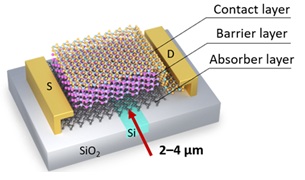
In this project, we will demonstrate a new photodetector architecture to suppress dark current and reduce noise based on a judicious combination of three different materials to approach an ideal band alignment. Conventional bulk semiconductor materials make it difficult to find matching materials for the desired band alignment of all the layers, particularly considering the limited palette of infrared-absorbing semiconductors. Furthermore, good quality epitaxial layer growth is difficult due to lattice mismatch resulting in lower quality interfaces between device layers. Van der Waals (vdW) materials, also known as 2D materials, offer a route to address these compounding challenges because of the shear variety of material combinations and their ease of integration into complex architectures and photonic circuits.
In this project, you will investigate mid-infrared photodetectors based on van der Waals materials and characterize their optoelectronic performance, first using mid-IR free-space optics, and finally integrating them on photonic circuits.
 Job Description
You will carry out photocurrent spectroscopy in the mid-infrared of photodetectors based on exfoliated materials. You will characterize photodetectors based on single van der Waals materials in detail and demonstrate the first prototype of a van der Waals heterostructure photodetector designed for dark current suppression.
You will use different fabrication methods for specific materials and construct vertical heterostructures out of thin layers for enhanced photoresponse with a shorter carrier pathway. We will harness a polycarbonate-assisted stamping process to transfer the vdW-materials with micrometric precision based on an existing setup in the Photonics Research Group.
Our laboratory is equipped with several tunable mid-IR sources (such as quantum cascade lasers and optical parametric oscillators), photodetectors, and a Fourier-transform IR spectrometer suitable for bulk crystals. You will characterize the bandwidth of the photodetectors by recording their temporal response and quantify noise equivalent power. Overall, this project will provide the background to work with mid-infrared photonics and optoelectronics in combination with integrated photonics.
Candidate Profile
- M.Sc. in Engineering Physics, Applied Physics, Electrical Engineering, Photonics, Materials Science, or similar subjects related to Photonics and Nanotechnology.
- Excellent written and oral communication skills.
- Dynamic attitude for finding solutions.
- Capacity to work both independently and as part of a team.
- A solid background in optics, optoelectronics, and semiconductor physics.
- Hands-on experience with nanofabrication, 2D materials, or infrared optics will be considered a plus.
- Experience with programming languages like Python and Matlab is a plus.
About Us
You will work in the Photonics Research Group, part of the Department of Information Technology (INTEC) at Ghent University and also associated to IMEC.
The project will be supervised by Prof. dr. Alberto Curto, co-supervised by Prof. dr. Dries van Thourhout with the direct involvement of Dr. Yujie Guo.
The Photonics Research Group (about 100 people) is headed by Prof. Dries Van Thourhout and has been active in photonics device research for many years. Professors in the group include Roel Baets, Peter Bienstman, Wim Bogaerts, Stephane Clemmen, Bart Kuyken, Alberto Curto, Nicolas Le Thomas, Yanlu Li, Geert Morthier, Gunther Roelkens, and Kasper Van Gasse. The main research directions include silicon nanophotonics, photonic (bio)sensors, heterogeneous integration, programmable photonics, and neuromorphic computing.
Apply hereMore informationRelated research topics
|